
Search Tuscola County Property Records
Start with whatever fact you already hold. An address will locate a parcel in Tuscola County FetchGIS. So will an owner name. So will a property identification number, called a PIN. The report may list the property address and a separate owner mailing address. It may also show current and prior tax-year data, building details, sales information, and tax history. Take that PIN and legal description into the recorded-document trail. The Official Record Search holds the deeds, mortgages, liens, easements, plats, and releases.
Each source plays a distinct role. FetchGIS finds the tax parcel. But the county warns its lines are approximate and no substitute for a survey. The Register of Deeds preserves recorded conveyances. Though an index hit is never a title opinion. Treasurer and assessor records supply the tax and value context. Court or probate files may reveal a foreclosure, quiet-title case, or estate transfer. Get certified copies from the custodian. When a question exceeds what public records prove, a surveyor or title professional takes over.
- Find the parcel by street address, owner name, or PIN in FetchGIS.
- Save the PIN, legal description, unit name, and report date.
- Search the latest deed by party name and recorded date.
- Check assessed values, taxable value, exemptions, and tax status.
- Request a certified copy or older office record when proof is needed.
Tuscola County Records Offices
Three county functions anchor the property trail. The Register of Deeds records conveyances and encumbrances. Equalization keeps assessment fair across local cities and townships and publishes annual reports, while each local assessor maintains the assessment roll feeding the parcel system. The Treasurer tracks current and delinquent taxes, receipts, payments, forfeiture, and foreclosure assistance. All three operate public counters in the county complex in Caro, and the published county pages list the authoritative phone, mail, and online routes.
Tuscola County Register of Deeds
125 W. Lincoln Street, Suite 400
Caro, MI 48723
989-672-3840
Tuscola County Equalization
125 W. Lincoln Street
Caro, MI 48723
989-672-3830
Tuscola County Treasurer
125 W. Lincoln Street, Suite 201
Caro, MI 48723
989-672-3890
Read Tuscola FetchGIS Results
FetchGIS offers several entries into Tuscola County property records. Parcel Search accepts a PIN, owner name, or street address. Intersection Search pairs two street names. Coordinate Search takes longitude and latitude. Other controls reach named features such as cemeteries and library branches. Selecting a parcel opens a report with multiple sections. Those sections may include owner and property addresses, class, principal residence exemption data, assessed value, state equalized value, taxable value, building data, sales, and tax history.
Keep the field labels straight. The property address marks the site itself, also called the situs. Owner Address is the mailing destination. It may be an estate, company, public body, or out-of-area contact. An address query can fail. Then try the PIN or an owner name, including a spelling variation. The report also names the local unit. That detail matters near Caro annexation tracts. It also matters where a Vassar postal address could mean Vassar City or Vassar Township.
| Starting clue | FetchGIS field | Save from result |
|---|---|---|
| Street and number | Street Address | PIN and unit name |
| Person or entity | Owner Name | Owner and mailing fields |
| Tax-map number | PIN | Legal description and tax year |
| Map point | Coordinate Search | Selected parcel report |
Tuscola Property Search Fields
The Tuscola Official Record Search offers Quick and Advanced.
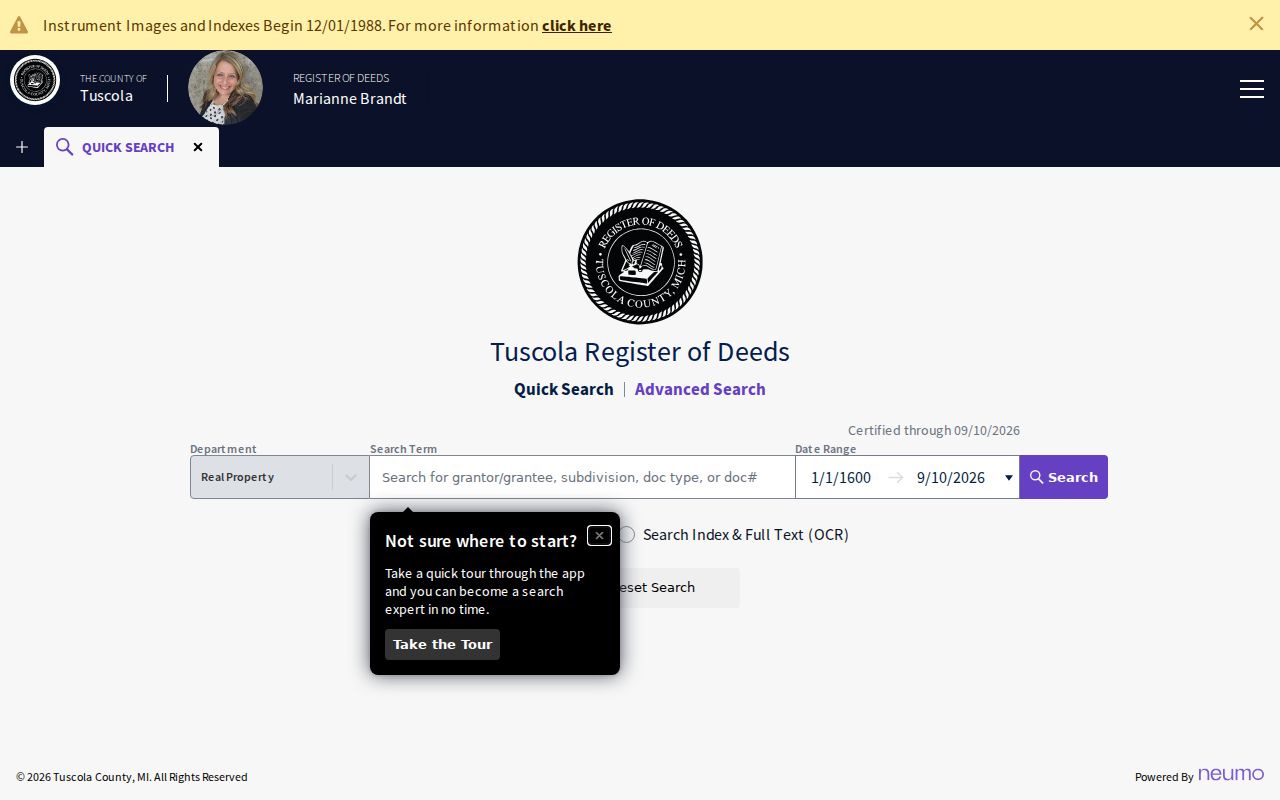
That screen is a natural second step once FetchGIS yields a name or legal-description clue. Begin with Search Index Only and a narrow party-and-date query. Full Text uses optical character recognition, or OCR, to read typed image text. It cannot promise a match against handwriting or a weak scan. Before relying on any hit, confirm the document type. Check the recording date, party role, reference, and property description too.
Tuscola Deed Records Span Two Eras
Tuscola County's online deed index reaches back to December 1988. Yet the Register of Deeds holds land records from 1852. That gap shapes the method. Modern transfers can start in PublicSearch. Older ownership work begins with the newest known deed. It follows the book, page, grantor, grantee, and legal-description references backward. The search then shifts to the office-held books and historical indexes.
A grantor transfers an interest; a grantee receives it. The portal's older vocabulary includes grantor-to-grantee and grantee-to-grantor ranges. It also covers deed and mortgage indexes, township and village cards, and a tract index. These categories explain why an old name may fail a modern general query. Search the historic index type, village, township, or tract instead. Ask Register of Deeds staff to retrieve any image that is not online.
Two dates, two channels. December 1988 marks the reported online start. The office research collection reaches 1852. An empty web result before the cutoff does not mean no deed exists.
Map Tuscola County Parcels
The county GIS page links FetchGIS, downloadable data, tax maps, plat resources, and map-print services. The viewer layers on aerial imagery, streets, school and library features, flood information, and several basemaps. Aerial imagery and flood data sit alongside several basemaps. Measure, draw, annotate, buffer, print, and parcel-report tools help compare a site to neighboring land. A buffer is a chosen distance around a parcel or drawing. Replace the viewer's default value before running one, then note the unit and distance used.
Map layers answer location questions, not legal-boundary questions. A plat is the recorded plan for a subdivision. A tax map helps administer parcels. A GIS line is a digital representation. The county calls it approximate and not field verified. For a fence, an easement, or a disputed line, compare the deed and plat. Then bring in a licensed surveyor. Michigan LARA also offers a subdivision-plat search route through Accela. It is filterable for Tuscola County and a subdivision name.
Tuscola County Property Record Types
No single office holds a parcel's full story. A recorded deed shows who transferred an interest in Tuscola County real estate and when. Mortgages, liens, releases, easements, land contracts, and plats layer additional rights onto that parcel. Assessment records, kept by the assessor, describe the tax parcel and its values. The Treasurer's side covers tax bills, receipts, and delinquency. It also tracks any forfeiture or foreclosure activity tied to the property. City permits and zoning files can describe proposed work. Caro and Vassar publish no public address-keyed permit database, though.
| Record Type | What It Documents | Kept By | Access |
|---|---|---|---|
| Deeds | Recorded transfers and legal descriptions | Register of Deeds | Web index, counter, copy order |
| Mortgages and liens | Recorded encumbrances and releases | Register of Deeds | Web index and office records |
| Tax and assessment | Values, class, PRE, balances, receipts | Local assessor, Equalization, Treasurer | FetchGIS, reports, request |
| Plats and parcels | Lot, block, map unit, nearby parcels | Register of Deeds, GIS, LARA | Viewer, PDFs, plat search |
| Permits and zoning | Proposed use and construction review | Caro or Vassar | Forms and office request |
Let the question pick the record. A recorded ownership chain or an easement points to Tuscola County deed records. Assessed and taxable values, PRE status, receipts, and delinquency belong in property tax records. Parcel maps answer location questions and show neighboring PINs. A permit form may add house-history color. But it never replaces the recorded deed and cannot settle a legal boundary.
Interpret Tuscola Property Tax Values
One Tuscola County parcel can carry several different values. Assessed value sits at 50 percent of true cash value under the state's framework. State equalized value, or SEV, reflects county and state equalization. Taxable value drives the actual tax bill. The constitutional cap holds it down until a transfer uncaps it. None of these equals a market appraisal or the consideration stated in a deed.
FetchGIS can display assessed value, SEV, taxable value, and class. It also shows the principal residence exemption, called PRE. The county Equalization office posts annual assessment-ratio and equalization reports. Questions about an amount, class, or PRE go to the local city or township assessor. The assessor also handles poverty exemptions, veteran exemptions, and Board of Review matters. The Treasurer handles balances and payments, not assessment changes.
Check the Treasurer FAQ for a delinquent bill or a receipt request. Include the PIN and the property address. Receipt copies run $1 per page. The county does not return them by fax or email. Plan on mail, the dropbox, or the counter. Confirm current instructions before sending any funds.
Tuscola Liens and Court Records
Liens and court cases leave two separate paper trails. The PublicSearch index spans mortgages, assignments, discharges, construction liens, federal tax liens, state tax liens, judgment liens, fixture filings, and releases. Pull the original instrument and any matching release. A release can surface under a changed party name or a much later date, so keep document numbers and legal descriptions handy while matching the sequence.
Foreclosure, quiet title, partition, and other property disputes start with MiCOURT Case Search. Choose the 54th Circuit, 71B District, or Tuscola Probate Court as the case type demands. The portal only locates cases. The clerk's file remains the official record, and some case categories never appear publicly. Tuscola's Circuit Court name-search form lets staff search when the online route falls short, and its copy form handles ordinary and certified copies.
Tuscola Property Alert Needs Review
The Register of Deeds Property Alert scans newly filed documents each day against a person or business name. It can also work from a property description or address. An email may include the document number and link. The recording date and matched criteria may appear too. A current owner wanting notice of later filings finds it useful.
An alert blocks nothing. It does not prevent fraud or prove a match is fraudulent. The county warns that errors and omissions remain possible and manual review is required. Open the instrument. Compare its legal description and parties to the parcel. Call the Register of Deeds through the official county number. Suspected forgery or a fraudulent conveyance calls for qualified legal advice, not a confrontation with anyone named in the index.
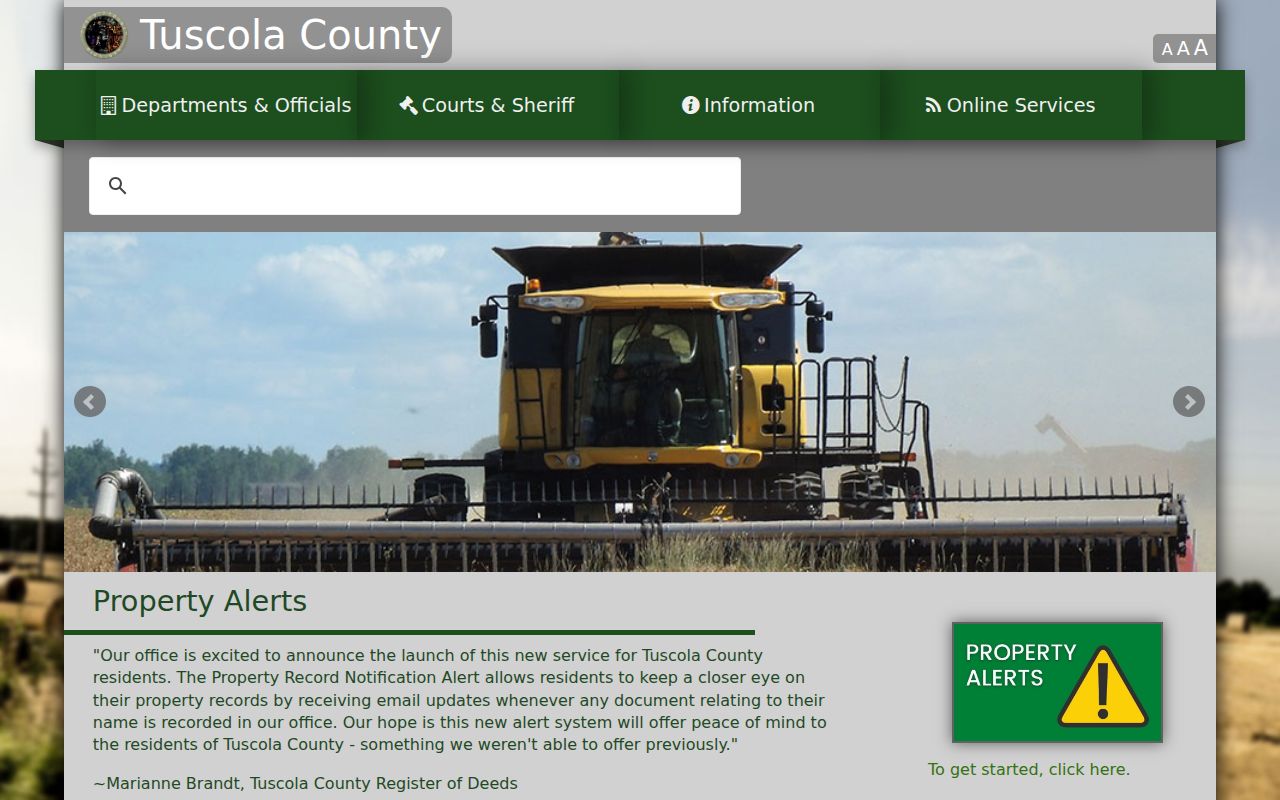
The county's own notice draws the same line. An alert is a prompt to inspect a filing, not a finding that fraud occurred.
Reach Older Tuscola Land Records
Some of the most useful Tuscola County property records still live on paper. The Register of Deeds counter is the main fallback for pre-1988 deed books, cards, and indexes. Land records are available for office research back to 1852. Staff there can explain copy and certification choices. A free index view, a per-page copy, and a certified document are three different products. Certification adds evidentiary form. The index merely identifies a filing.
Tax maps add geographic context. The current and archived township or city PDFs include vintages reaching into the 1980s and 1990s. Put the map year beside any observation drawn from it. The Library of Michigan, Archives of Michigan, Tuscola Genealogical Society, and local historical societies may hold directories, newspapers, vital indexes, census material, and photographs. Those sources can explain names, roads, and occupancy. But none converts into ownership without a deed or court order.
Michigan's Freedom of Information Act opens another channel for defined government records. No standard office form covers these. Describe the record, date range, and property closely enough for the public body to find it. Fees and exemptions may apply. Start with the custodian's ordinary counter, phone, mail, or copy method. It is often more direct than a broad FOIA request.
Caro and Vassar Property Records
Tuscola County contains two incorporated cities. Caro serves as the county seat. Vassar is the second city. Cass City is a village, not a third city. The county offices hold deeds, tax rolls, and parcel records for both cities. Each city office layers on its own zoning, permit, planning, and land-use files.
Caro property records deserve extra care around tracts annexed from Almer and Indianfields townships. A current Unit 050 CARO entry can sit next to an older township legal description. Caro's zoning forms preserve proposed use, construction details, size, and plot plans. Vassar property records carry Unit 051 VASSAR CITY markers. Legal descriptions there include Assessor's Plat City of Vassar, North's Add, and Plat of City of Vassar. The Cass River also makes floodplain and permit review a real factor there.
Tuscola Property Records Have Limits
An official Tuscola County record can name an assessed owner or a recorded grantee. It can also list a tax parcel, declared sale figures, a mortgage, a lien, or a plat. A court case or a permit request may appear as well. Each was created for a different purpose. A just-recorded deed can be newer than the tax roll. A mailing address may not match the property address. The PRE field is a tax clue, not proof someone lives on site. A business filing explains an entity name but does not establish that entity's title.
Privacy rules still govern public material. Michigan's Address Confidentiality Program can substitute a designated address for an eligible survivor's residence. FOIA exemptions may shield personal, medical, security, and identifying details. Do not piece together voter, business, tax, and parcel records to guess a hidden address. Record only what the property question needs. Keep the source date. Report an exposed protected identifier to the custodian instead of republishing it.
Lawful use. Tuscola County property records support purchase research, estate work, boundary questions, tax review, and civic transparency. They do not replace a title search, appraisal, certified court file, or survey, and owner details must never be used to stalk, harass, threaten, or expose a protected address.