
Trace Tuscola County Former Owners Backward
A former owners search in Tuscola County starts with the newest verified deed. It then moves backward one transfer at a time. The Tuscola Official Record Search indexes parties, document types, dates, and land-description clues, so build a worksheet instead of trusting a bare list of names.
| Transfer date | Grantor to grantee | Deed type | Book, page or instrument |
|---|---|---|---|
| Newest matching date | Seller to current grantee | As indexed | Copy exact reference |
| Earlier acquisition | Earlier grantor to that seller | As indexed | Match description |
| Repeat backward | Prior owners in sequence | Note warranty, quitclaim or other type | Preserve every citation |
Every row in the worksheet should connect through both a party name and the same land. A name match without the parcel description does not reconstruct the chain.
Walk the Tuscola County Deed Chain in Reverse
Open the latest deed reference first. Note its grantee, grantor, and legal description. Recording date matters too. Then search that grantor as a prior grantee, and repeat the cycle while logging any gaps in the chain.
- Start with the current parcel PIN and newest matching grantee.
- Copy the exact grantor and description from that deed entry.
- Search the grantor in the grantee direction for an earlier acquisition.
- Match township, village, subdivision, lot or metes-and-bounds wording.
- Continue until the online line ends, then switch to historic indexes or staff help.
This method keeps former owners tied to transfers rather than to unsourced family stories.
The December 1988 Tuscola County Online Line
The county's Register of Deeds sets December 1988 as the start of its modern online land-record indexes. Books in the office itself reach back to 1852. Portal labels include deed index ranges, grantor-to-grantee and grantee-to-grantor series, township and village cards, and a tract index.
The official deed search screen opens the modern line.
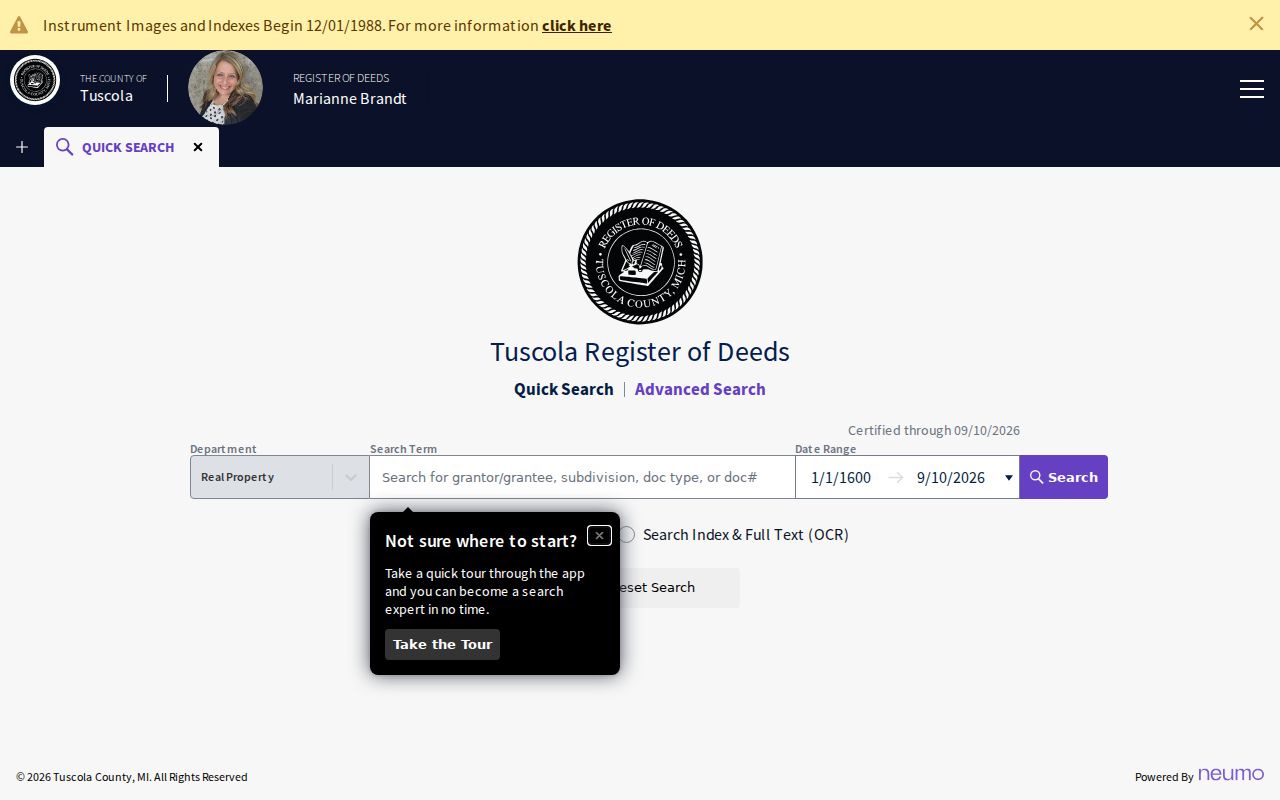
The screen opens the online trail, while older ranges may still require office research.
Do not stop at the web cutoff. Tuscola County's online line starts in December 1988, while older former owners may be found in deed books, cards and office indexes extending to 1852.
A range label does not guarantee its images. When a scan is missing, record the range name and ask Register of Deeds staff for the book, card, or image.
Tuscola County's Split Historic Index Is a Clue
Tuscola County's portal does not offer one seamless old-name database. It splits everything by range and card. Deed ranges run IDXD01 through IDXD17. GTE ranges run IDXDE01 through IDXDE28. GTR ranges run IDXDR01 through IDXDR28. Mortgage ranges and separate place cards sit alongside them. That vocabulary explains empty-looking searches. The split is a clue, not a dead end.
Try the former owner's spelling first. Then try the village or township card. Also try the tract description and any known book reference. Village cards cover Caro, Vassar, Cass City, Mayville, Millington, and other places. Township cards cover units such as Almer, Indian Fields, Denmark, and Vassar.
Note: Treat 1852 as the conservative start even though a few range labels display 1851/1852.
Read Tuscola County Former-Owner Terms Correctly
Index terms carry distinct roles, and a clean timeline depends on using them consistently.
Grantor: the party conveying the recorded interest. Grantee: the party receiving it.
Chain of title names the sequence of instruments connecting interests over time, while a reverse index is the grantee-oriented route used to locate an acquisition.
A warranty deed conveys with stated covenants, but a quitclaim deed transfers whatever interest the grantor held, without the same covenants.
Deed type alone proves nothing about title quality, so preserve the instrument text and legal description.
Probate Can Break a Simple Tuscola County Sequence
A death, an estate, a trust, a court order, or a life estate can break the tidy seller-to-buyer pattern in Tuscola County deed records. When a former owner vanishes from the chain without an ordinary deed, probate is often the reason. Tuscola Probate Court can be reached at 989-672-3850, and public docket information may appear in MiCOURT.
Wills themselves stay out of public view in MiCOURT. Ask the court for the specific probate file or order you need. Then go back to the deed index for the recorded evidence that actually moved the land. Death notices and genealogy sources can link a person to an estate. Still, they never replace a deed or court order affecting the parcel.
Mortgages and Releases Add Tuscola County Context
Mortgages and releases fill quiet periods. Tuscola County labels include a mortgage index, grantor and grantee mortgage series, and a Mortgage Discharge Index. Modern document types include mortgages, assignments, modifications, partial releases, and discharges.
These instruments can explain a changed lender, a released lien, or a legal-description variation. They do not automatically add a former owner. Keep them in a separate evidence column. The transfer timeline stays clear that way.
Historic Sources for Tuscola Prior Owners
The Register of Deeds counter sits at 125 W Lincoln Street, Suite 400, in Caro. It is the pre-1988 fallback. Hours are weekdays 8:00 to 4:30. The office closes noon to 1:00. Bring names, date bands, township or village, tract language, and the newest known reference.
Request one missing link at a time. State the known later deed, its grantor, the likely acquisition period, and the exact land description. Copies cost $1 per page. Certification adds $5. Label a name found only in a mortgage, probate file, or directory as context until a conveyance or order connects it to the parcel.
The Archives of Michigan county guide, the Library of Michigan, local libraries, and historical societies add directories, newspapers, photographs, and place-name context. They help interpret the chain. The recorded deed still governs. For the current endpoint, see the current property owner record; for copy fees and document mechanics, use the deed records guide.
Choose the Right Tuscola County Historic Range
The old index vocabulary in Tuscola County reads like a roadmap. Deed ranges IDXD01 through IDXD17 cover labeled periods from 1852 through 1931. Grantor-to-grantee ranges IDXDE01 through IDXDE28 and grantee-to-grantor ranges IDXDR01 through IDXDR28 begin with labels from 1851/1852. They run through 1991. Mortgage index ranges and separate discharge records add a parallel financing trail. That trail can confirm when an interest was released.
Begin with the approximate year of transfer. Direction matters just as much. Tracing backward from a known later owner works best through the grantee-oriented range. That range helps locate the person's acquisition in the deed records. The matching grantor entry then points to whoever held the interest before the transfer. Copy the exact index range, page, or card reference. Staff can then pull the underlying deed book or image.
Place cards deserve equal attention. The portal labels cards for Caro, Vassar, Cass City, Millington, Mayville, and other villages. Township cards across Tuscola County appear too. A tract index offers another route when party spelling fails. Switch methods deliberately. Note which index was checked. An empty modern term search does not prove an absence of earlier owners in the property records.
Test Each Tuscola County Chain Gap
A gap in the chain of title deserves a defined follow-up, not a guess. Check whether the land description changed through a subdivision plat, parcel split, condominium master deed, or land contract. A court order counts too. Search both spelling variants and marital or estate forms of the name. Then hunt for probate filings, sheriff deeds, treasurer deeds, and certificates of redemption. Also look for other documents that look nothing like an ordinary warranty deed.
Tuscola County's court route draws on MiCOURT public case information. The County Clerk holds the underlying circuit files. A request can identify the plaintiff, defendant, case number, document, and filing date. Name searches for 1989 to the present cost $5 per name. Older years add a per-year charge. The Clerk accepts defined copy requests. Ordinary circuit copies are listed at $1 per page.
Sometimes web and court checks still leave a break. In that case, bring the recorder the last sound link on each side of it. Include both legal descriptions, dates, and instrument references. The final timeline should display the gap openly. Only a recorded deed, probate order, or court judgment can connect the former owners. An honest gap beats an invented transfer in any property search.
Preserve negative searches too. Record the exact spelling, date band, index range, and place card checked, so the same incomplete route is never mistaken later for a complete history of the property records.