
Tuscola County Deed Records Trail
Deed records in Tuscola County document each recorded transfer. They also track the instruments that can shape ownership of land. The Register of Deeds indexes deeds together with mortgages, liens, easements, plats, land contracts, releases, court documents, and treasurer filings. Look closely at any deed you pull. It names the parties and gives the recording date. It also cites a document reference and may carry indexed legal-description text. Keep in mind it reflects what the office accepted for recording. That is not a legal opinion that every competing interest was cleared.
| Deed Type | What It Does | Common Use |
|---|---|---|
| Warranty deed | Conveys the stated interest with deed covenants | An ordinary sale |
| Quitclaim deed | Conveys whatever interest the grantor has | Family or title cleanup transfers |
| Sheriff deed | Records a transfer from a sheriff process | A foreclosure-related chain |
| Mineral deed | Conveys a stated mineral interest | Separating subsurface rights |
| Land contract | Records seller-financed contract rights | A purchase paid over time |
Mortgages and liens work differently from deeds. Each one is an encumbrance, a claim or burden attached to the land or to a party. Before assuming an older entry is still open, hunt for the matching discharge, release, assignment, modification, or partial release in the same records.
Tuscola Deeds Span Two Eras
The Tuscola County Register of Deeds sits at 125 W Lincoln Street, Suite 400. That office is in Caro, Michigan 48723-1591. The counter takes visitors on weekdays from 8:00 a.m. to 4:30 p.m. It closes from noon to 1:00 p.m. You can also call 989-672-3840. County guidance places the start of the online land index at December 1988. Land records reaching back to 1852 remain available for research inside the office.
That two-era split shapes any deed search. Start with a recent deed and follow its prior reference into grantor-to-grantee or grantee-to-grantor indexes. Older deed books, township cards, village cards, and tract-index material extend the trail further. One caution applies, though. An old range label appearing online does not prove every related image is available remotely. Recording the portal certification date helps too, since indexing continues to advance.
The county's historic vocabulary runs unusually deep. Deed-index ranges span 1852 to 1931, and directional GTE and GTR ranges run into 1991. Village cards for Caro and Vassar sit beside cards for local townships and other villages. Those categories reflect how land research once moved through books, cards, parties, and geography. It did not depend on a single modern address. The Register of Deeds coverage page states the online cutoff. It also notes the deeper office-held span.
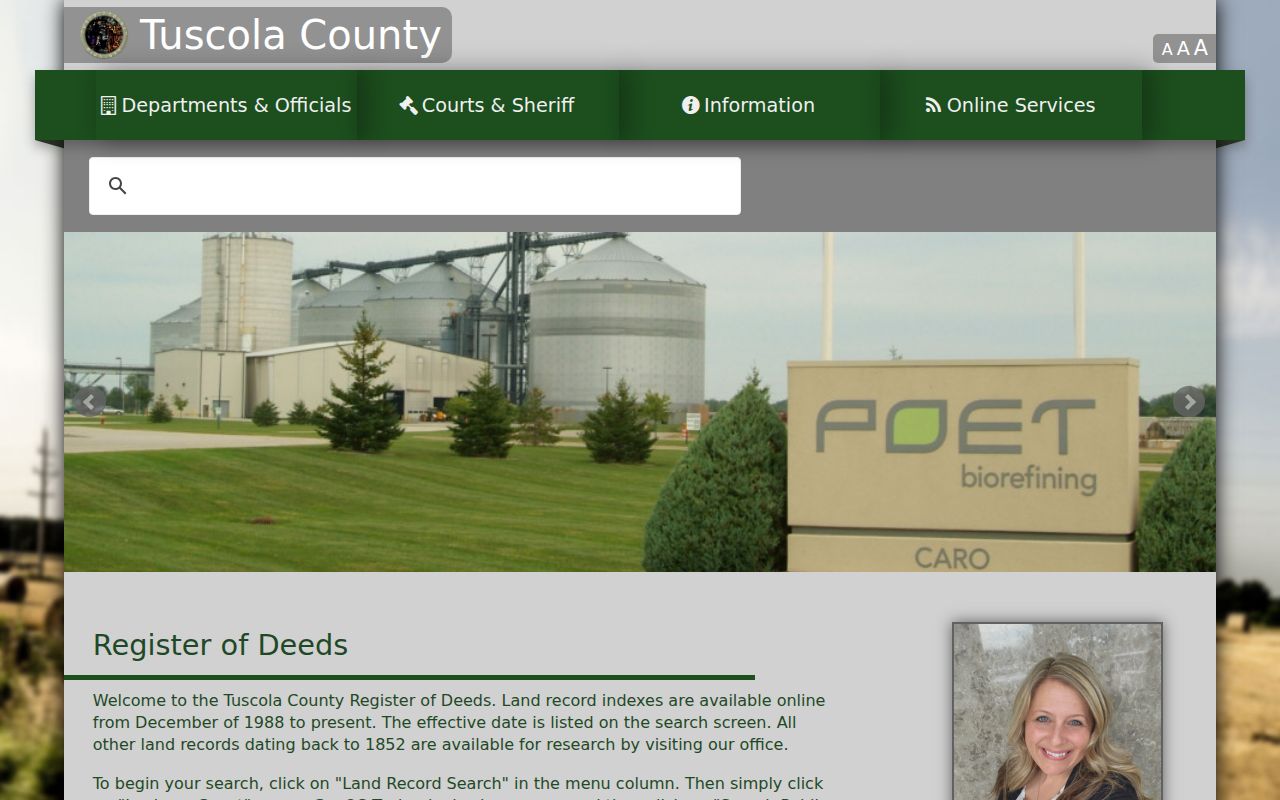
A miss in the online index is never the end of a Tuscola County deed search.
Search Tuscola County Deed Records
The county's Official Record Search greets guests with two paths, Quick Search and Advanced Search. Tuscola County's own instructions point visitors toward Land Record Search, then Login as Guest, then Search Public Records. Start with the index metadata alone. Turn on OCR text matching only after a party name, date range, subdivision, or document type has already narrowed the results, since typed-text recognition can stumble over handwriting and poor deed scans.
| Field | Format | How it helps |
|---|---|---|
| Department | Dropdown | Choose Real Property |
| Search Term | Optional text | Grantor, grantee, subdivision, type, or document number |
| Recorded Date | From and to | Limit a common name or event window |
| Index Only | Default scope | Search the indexed fields |
| Index & Full Text | OCR option | Search document text where OCR exists |
A single result can pack in a lot. Party roles, document type, and recording date sit alongside the instrument number, book and page, and the full legal-description text. An image or cart control appears where one exists. Guests get no promised free images, no fixed result limit, and no bulk export. The official Tuscola deed-search screen lays out the department, the date fields, and the index-versus-OCR choice. These appear exactly as a guest sees them.
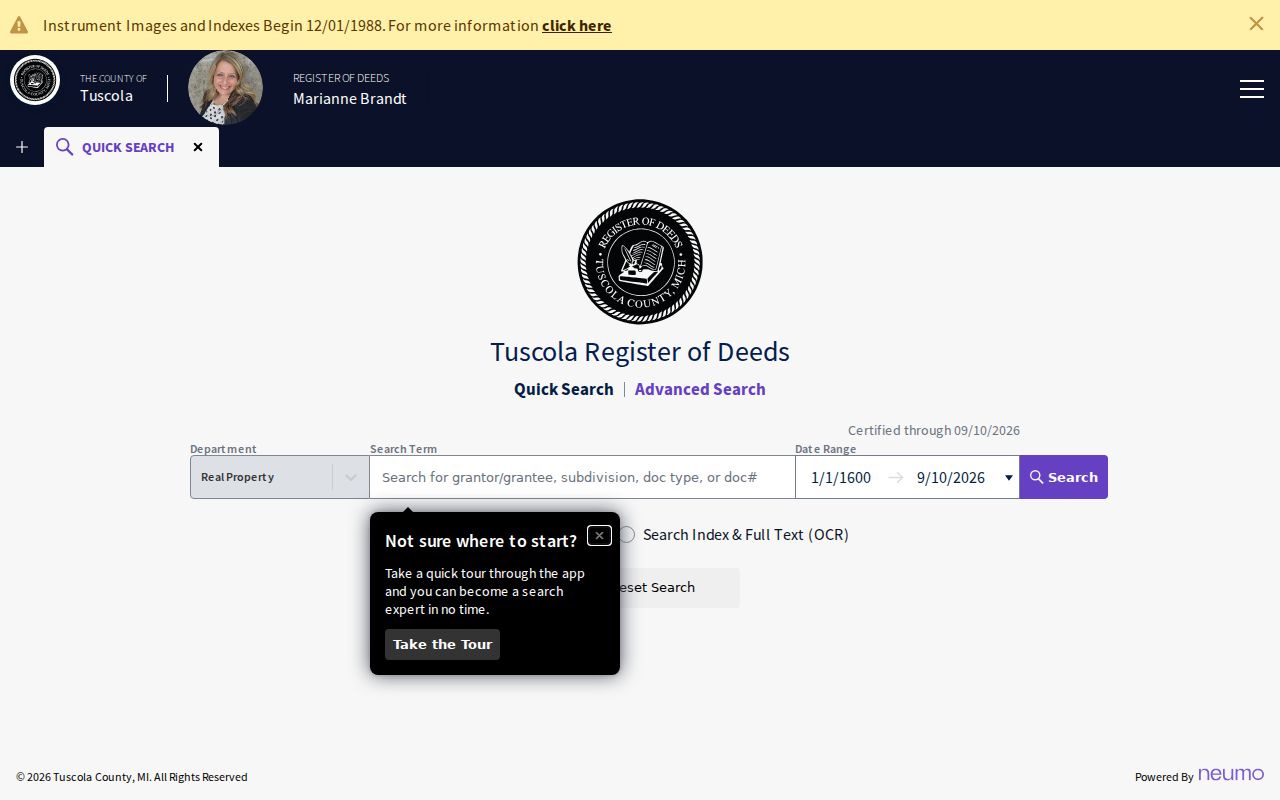
The image shows why a narrow index query beats full-text recognition on the first pass.
Walk Tuscola's Deed Index Backward
Every deed names two sides. The grantor conveys the interest; the grantee receives it. String those conveyances together for one parcel and you have the chain of title. To walk it backward in Tuscola County, begin with a confirmed current deed rather than an assessment name alone, and keep the legal description in view at every step so the trail stays on the same land.
- Find the newest purchase deed with the current recipient indexed as grantee.
- Read the grantor, legal description, recording date, and document reference.
- Search that grantor as an earlier grantee and confirm the same land description.
- Repeat until the chain crosses the December 1988 online line, then use the named historic index range and office records.
- Grantor
- The party transferring the stated interest.
- Grantee
- The party receiving the stated interest.
- Chain of title
- The linked sequence of recorded transfers for the land.
- Book/page
- An older volume-and-page reference, distinct from a modern instrument number.
Tuscola Deed Liens and Releases
The land records index sorts instruments by type, and the divisions matter. Mortgages, assignments, modifications, partial releases, and discharges each get their own label. The same menu covers federal and state tax lien variants. It also lists fixture filings, farm-land filings, lis pendens, restrictions, easements, and oil and gas instruments. Treasurer foreclosure and redemption filings appear too. The categories only pay off when you read related entries together. Pull an old mortgage without its matching discharge. The chain then looks heavier than it really is.
Work from exact names first. Then try likely variants, and check the parcel description against the recording sequence. For an LLC or corporation, the Michigan business entity route can confirm the legal-name form on file with the state. Michigan moved that system to the MiBusiness Registry Portal in 2025. Keep one caution in mind. An entity filing does not establish who owns a Tuscola County parcel.
Note: A court document or lis pendens in the land index is only a lead. The court clerk holds the actual case file.
The county's Property Alert page describes a daily scan of new deed filings and other recorded instruments.
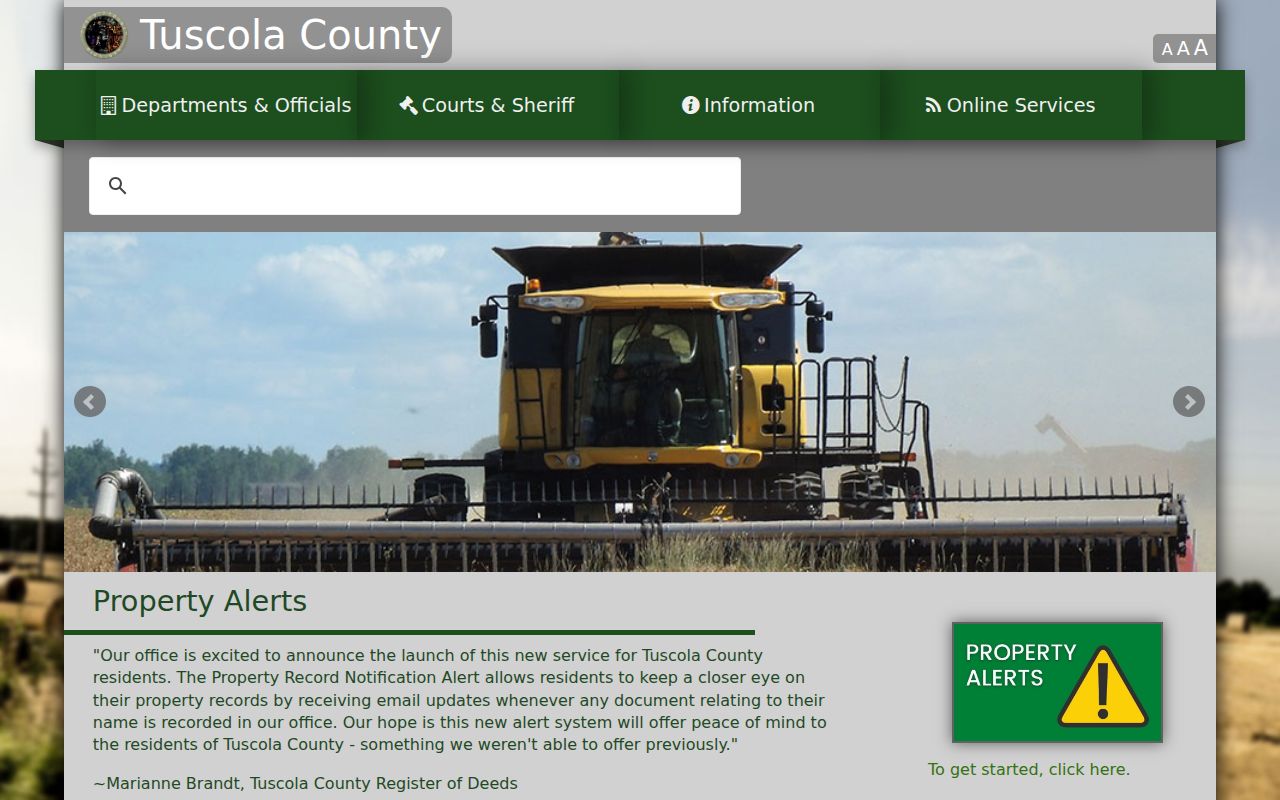
The Property Alert page also carries a warning. An alert still needs manual review, and it does not prevent fraud on its own.
Plats Support Tuscola County Deeds
A deed can describe land several ways. It may cite a subdivision lot and block, a section-township-range parcel, or a metes-and-bounds tract. Acreage and condominium units show up too. Search the description from the deed itself rather than leaning on a street address. Addresses can change. The legal description holds steady.
The county portal backs this up with dedicated categories. These include PLAT, SURVEY, land corner, condominium master deed, amendment, and easement. Michigan LARA supplies the state subdivision-plat search. The agency notes that online plat searching began in January 2019. Tuscola County tax maps and FetchGIS both help you locate land. Just remember their legal weight differs. A plat documents a land division. A tax map aids assessment, and a GIS line is approximate. When a boundary is in dispute, a licensed survey and the recorded instruments control.
Tuscola Property Alert Watches Filings
The Register of Deeds runs a daily Property Alert scan over newly filed documents. A person or business name can be watched. So can an existing description or address. A match triggers an email. The message includes the document number, a link, the recording date, and the criterion that matched.
The service is a notice tool, not fraud prevention. The county cautions that it cannot stop a filing, guarantee a match, or judge whether a conveyance is fraudulent; examine any suspect instrument manually and contact the Register of Deeds, counsel, or law enforcement.
Order Certified Tuscola County Deeds
Tuscola County charges $1 per page for real-estate and fixture copies. State and federal tax-lien, and plat copies cost the same per page. Certification adds $5 per document. A state or federal lien-search certificate is $3 per name. Extra statutory charges can follow the request type. Consult the current Register of Deeds fee schedule before ordering.
Online-era records go fastest. Note the instrument number and use the portal's image or cart route. The counter and mail routes remain as backup. Older deeds may still require book or card research. Maps, directories, and context from state archives, the Library of Michigan, and local historical societies enrich the picture. None of them replaces the recorded conveyance itself.
Recorded, not guaranteed. Tuscola County deed records show accepted filings. They do not guarantee clear title, resolve every unrecorded interest, or substitute for a legal title examination.
A free index hit, a $1-per-page copy, and a certified copy with its added document fee serve different purposes. Use the index to locate. Use the copy to read. Request certification only when an official reproduction is required.
An older chain of title rewards preparation. Bring every clue already gathered: party names and their variants, the newest instrument or book and page, the township or village, the subdivision, and legal-description words. Inside the portal, the IDXD deed ranges, the GTE and GTR directional indexes, mortgage ranges, township cards, village cards, and the tract index can each point toward the next source. Not every image is online. A modern deed's backward reference is often the cleanest bridge into the office-held books.
Context is easy to find. County tax maps, the Archives of Michigan county guide, the Library of Michigan, and a local historical society can all help. A directory, census entry, newspaper item, or photograph may place a person near the property. None of it proves a conveyance. Keep that context separate from the Tuscola County deed records that actually transfer the stated interest.
Before closing the search, revisit the names. Check each party-name variant for releases and corrective instruments. Compare the document number, recording date, legal description, and parcel clues across the whole sequence. A certified copy authenticates the office reproduction, but it cannot resolve an unrecorded claim. Preserve the full instrument trail. For a purchase, a disputed interest, a suspected forged filing, or a complex estate transfer, take that trail to a qualified Michigan real-estate attorney or title professional.